Utah · Criminal Defense · Civil Rights · Appeals
Is a mushroom church protected from prosecution? Singularism's case in Utah
Singularism lost its appeal over an order blocking its founder's prosecution, but a separate Utah religious-freedom injunction was outside the appeal. Church membership alone does not answer whether your use of psilocybin is protected.
- Written by
 Emily Chen
- Published
- Decision
- October 5, 2026
- Case
- Jensen v. Utah County, No. 25-4115
At a glance
The practical result
- Court
- Tenth Circuit, unanimous 3-0
- Outcome
- Prosecution-blocking order to be lifted
- Law
- First Amendment and Utah controlled-substance law
- Immediate effect
- Case returns to the trial court; charges not refiled as of Oct. 5; separate state-law injunction not decided
In this article
- What the Tenth Circuit decided about Singularism
- How a mushroom church works
- Why Utah's medical exception did not protect Singularism
- Why the federal court could not stop Jensen's prosecution
- Which religious-freedom and search claims remain
- How Singularism's case reached the appeals court
- Are mushrooms legal in Utah after this ruling?
- What happens next in the Singularism case
- What to verify before relying on a church's legal protection
- Mushroom church FAQs
Short answer: No, joining a mushroom church does not automatically protect you from drug prosecution: on October 5, 2026, the Tenth Circuit directed a lower court to lift the order blocking Utah's prosecution of Singularism founder Bridger Lee Jensen. The panel rejected his argument that Utah's medical exception for psilocybin gave his religious use the same First Amendment protection. A separate injunction under Utah's religious-freedom law was not appealed, so the decision does not settle every claim in Singularism's case.
What the Tenth Circuit decided about Singularism
Singularism lost the part of the appeal that had stopped its founder's criminal prosecution. The state charges were dismissed while that order was in force, and Courthouse News reported that prosecutors had not refiled them as of October 5, 2026. The unanimous panel sent the case back to the District of Utah with instructions to vacate, meaning cancel, that injunction. The trial court must also revisit its decision to let one part of Jensen's First Amendment claim continue. That part argued that Utah favored medical psilocybin use over religious use.
Judge Robert Bacharach wrote the opinion, joined by Judges David Ebel and Richard Federico. Utah County, Provo City and county attorney Jeffrey Gray brought the appeal against Jensen, Singularism and Psyche Healing and Bridging. The decision concerns the legal protection Jensen sought against prosecution, not a verdict finding him guilty.
For someone considering a ceremony in Utah, the result is a reason to ask what protection actually covers their situation. A prior favorable ruling is not enough when it involves a different order, claim or person. A criminal defense lawyer can assess a charge and the defenses available in the court hearing it.
How a mushroom church works
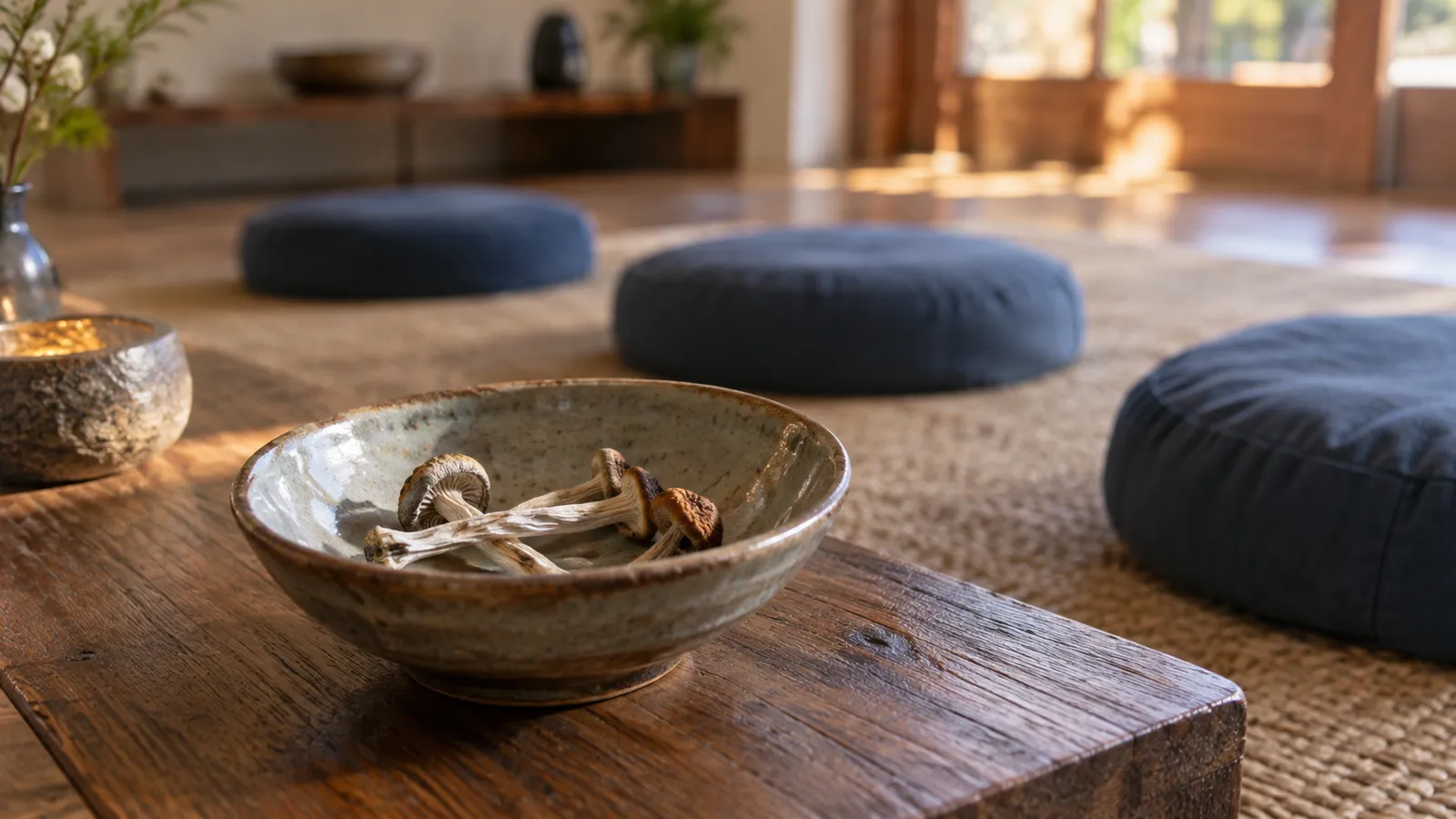
A mushroom church uses psilocybin mushrooms as part of a claimed religious practice, often calling them a sacrament. In Singularism, members called voyagers participate in ceremonies intended to connect with the Divine; the trial court's order says the mushrooms are used only as a sacrament and are never sold or otherwise distributed to non-affiliates for recreational purposes, although Singularism charges about $1,600 per tea ceremony.
The trial court's February 2025 order describes Singularism's preparation and facilitated ceremonies. It found the plaintiffs likely to succeed under Utah's Religious Freedom Restoration Act, or RFRA, which protects sincere religious exercise against certain government burdens. That was a preliminary ruling, made while the lawsuit continued, rather than a permanent exemption for any organization using the word church.
Churches can operate very differently. In February 2026, NPR reported on Zide Door in Oakland, California, where members could make donations and receive substances called sacraments. That access model is different from the facilitated ceremonies described in Singularism's case. Neither a membership arrangement nor the name of a sacrament tells you which law or court order applies.
Calling an event a church ceremony also does not turn it into licensed medical treatment. A spiritual gathering and a psychedelic retreat may share religious language, but an organizer's description cannot substitute for the legal authority to possess or provide a controlled substance.
Why Utah's medical exception did not protect Singularism
Utah's medical exception did not give Singularism the same protection, because the court compared the safeguards required by law. The panel held that regulated healthcare use and Singularism's religious use did not pose comparable risks to the public-health interests Utah asserted.
Singularism argued that Utah could not permit nonreligious use of psilocybin while forbidding religious use of the same drug. That comparison can matter under the First Amendment: a law that favors comparable nonreligious conduct may need a much stronger justification. But the panel examined how Utah's healthcare exception was structured and implemented, not just the substance being used.
Qualifying healthcare systems must meet statutory eligibility requirements. Their treatment programs must keep use under the direct supervision and control of the system and its licensed providers, and must report outcomes and side effects. Licensed hospitals also operate under pharmaceutical and psychiatric-service regulations. Those requirements put the healthcare exception on a different footing from a religious group's voluntary precautions.
Singularism said it had its own safeguards. The panel nevertheless treated mandatory medical oversight as a decisive difference, noting that Singularism itself told participants that professional clinical advice superseded its spiritual advice on medical matters. The ruling does not say voluntary precautions have no value; it says they did not establish the legal comparison needed for this argument.
| The comparison | What the panel relied on |
|---|---|
| Who can provide treatment | The healthcare exception is limited to qualifying systems, not any person or organization. |
| Medical supervision | The law requires direct supervision and control by the system and licensed healthcare providers. |
| Accountability | Required reports and hospital regulations address patient outcomes and side effects. |
| Singularism's precautions | Voluntary safeguards did not make the religious use comparable under this First Amendment argument. |
Why the federal court could not stop Jensen's prosecution
The panel said Jensen should have raised his constitutional defenses in the state criminal case instead of using the federal civil case to stop it. The rule behind that result, called Younger abstention, ordinarily keeps federal courts from interfering with ongoing state prosecutions when the state court can hear the constitutional issues.
The parties agreed that the ordinary requirements for abstention were satisfied. Singularism argued that the authorities had given up that objection by moving the civil lawsuit to federal court and litigating there. The panel rejected that argument: choosing a federal forum for the civil case did not surrender the state's position about the separate criminal case.
Jensen also argued that bad faith and irreparable harm justified an exception. The panel found that he had not met the heavy burden required. It said the alleged injuries could be addressed through the state proceeding or an appeal, and the evidence did not establish bad faith or harassment in the prosecution itself. That is a ruling about when another court may intervene, not a finding that every action by police was lawful.
Which religious-freedom and search claims remain

The appeal did not resolve Singularism's separate protection under Utah RFRA. Footnote 11 explains that the trial court used that state law to order the return of seized items and prohibit interference with the plaintiffs' sincere religious use of psilocybin. The authorities had not appealed that preliminary injunction, and the panel expressed no opinion on its validity.
This distinction gives the church a reason to keep pursuing its case. Its attorney Tanner Bean told Courthouse News, "the best claim is still in district court." That is his assessment of the remaining Utah RFRA claim, not an appellate ruling that the church will win. A civil rights lawyer can distinguish a statutory religious-freedom claim from a constitutional one.
The panel also left the trial court to decide the argument about individualized exemptions. Singularism pointed to an agency's power to excuse some medical licensing requirements, arguing that discretionary exceptions could trigger stricter constitutional review. The panel found that argument insufficient to save this injunction on appeal, but did not decide how the trial court should resolve it.
The Fourth Amendment claim, concerning the search and seizure, was outside the panel's appellate jurisdiction too. Dismissing that part of the appeal did not dismiss the underlying search claim. A separate Flock camera search ruling illustrates why a search dispute has its own legal question; the Singularism panel did not decide whether this search was unconstitutional.
| Issue | Result in this appeal |
|---|---|
| Order blocking state prosecution | Trial court directed to vacate it. |
| Preferential treatment for medical use | Panel rejected equating the risks of regulated healthcare use and Singularism's religious use. |
| Individualized licensing exemptions | Left for the trial court; appeal of the refusal to dismiss on that issue dismissed for lack of jurisdiction. |
| Fourth Amendment search claim | Appeal dismissed for lack of jurisdiction; no decision on the underlying claim. |
| Separate Utah RFRA injunction | Not appealed; the panel did not decide its validity. |
How Singularism's case reached the appeals court
The dispute began with a search in November 2024 and developed into separate criminal and civil proceedings. The trial court's Utah RFRA injunction came before the October 2026 appeal, which addressed the different order blocking prosecution.
Provo police search Singularism's spiritual center and seize mushrooms and other items.
Jensen and Singularism bring their civil lawsuit in Utah state court.
The defendants move the civil lawsuit to federal court.
Authorities file criminal charges against Jensen after the federal court's temporary restraining order.
Judge Jill N. Parrish grants a preliminary injunction under Utah RFRA, ordering return of seized items and barring interference with the plaintiffs' sincere religious use.
Judge Parrish orders Utah County and its attorney to stop the state prosecution of Jensen.
The Tenth Circuit directs the trial court to vacate the prosecution-blocking injunction, rejects the medical-use comparison and leaves other issues unresolved.
Are mushrooms legal in Utah after this ruling?
No, the ruling did not generally legalize psilocybin mushrooms in Utah. The opinion identifies psilocybin as a controlled substance prohibited under state law and explains the narrow healthcare exception. A court order protecting particular plaintiffs is a separate question from whether anyone may possess or distribute it.
Federal law is another layer. The DEA classifies psilocybin as a Schedule I substance under the federal Controlled Substances Act. This appeal concerned Utah officials and state prosecution; it did not grant a federal exemption. Protection from one government actor should not be mistaken for permission binding every other one.
Suppose you join a church because you heard it won a court case. Your membership alone does not establish that you are covered by that order, that your planned conduct falls within it, or that it addresses federal enforcement. The useful legal question is the reach of the actual protection, not whether the organization calls its mushrooms sacred.
Legal status also does not establish medical safety. The DEA describes panic reactions and paranoia among psilocybin's possible effects, and warns about poisoning from misidentified mushrooms. Clinical health questions require medical judgment; this court case provides neither a dosing guide nor a finding that a ceremony is safe for you.
What happens next in the Singularism case
The case returns to the District of Utah for the actions the panel ordered and for the issues it left undecided. The next procedural milestones are any rehearing request and the mandate, the appeals court's formal instruction returning the case to the lower court.
Under the ordinary rehearing rule, a party has 14 days after judgment to seek rehearing in a civil appeal like this one. Counting from October 5 gives October 19, 2026. The mandate rule ordinarily adds seven days after that period expires, giving October 26 if there is no timely rehearing request, timely motion to stay the mandate or court order changing the timing. These are ordinary-rule calculations, not confirmation that the mandate has issued or that a hearing is scheduled.
An appeals lawyer can explain how a rehearing or stay affects an order's timing. Singularism's case also belongs to the broader question of when federal courts can stop government action: the legal basis for an order matters as much as the headline describing it.
What to verify before relying on a church's legal protection
The actual court order and the conduct it covers are the starting point for assessing protection. This is general information, not legal advice; a notice or criminal charge needs a lawyer's assessment of the particular facts and deadlines.
- The protected parties: whether an order applies to the organization, its leaders, members or another defined group.
- The conduct covered: what the order says about possession, religious use and distribution, and any conditions it imposes.
- The government involved: whether the protection concerns specified state officials or also addresses federal law.
- Later changes: any rehearing, mandate, stay or new trial-court order affecting the claimed protection.
- Your own notice or charge: the court, alleged conduct and response dates, rather than an assurance based only on membership.
- Health concerns: whether a licensed clinician has addressed your individual medical questions; spiritual assurances are not clinical clearance.
Mushroom church FAQs
What does a mushroom represent spiritually?
There is no single meaning established by this ruling. Singularism regards psilocybin mushrooms as a sacrament that helps participants connect with the Divine. That describes this group's belief, not a scientific finding or a belief shared by every religion.
What is the relationship between psychedelics and religion?
Some religious groups use psychedelics as sacraments in ceremonies intended to create a spiritual experience. Singularism is one such group. The Utah dispute concerns how the law protects that practice, not whether taking a psychedelic necessarily creates a religious experience.
Is Zide Door legal after the Utah ruling?
This ruling does not decide Zide Door's legal status. Zide Door is the Oakland organization described in NPR's February 2026 report, while the appeal concerns Singularism and Utah officials. A different church cannot establish protection simply by pointing to the Utah case.
Need a lawyer?
Dealing with something like this?
Legal issues like this affect people and businesses differently. A lawyer can explain what it means for you, and we can help you find one in Utah.
Juricue is not a law firm and doesn't give legal advice. Contacting us doesn't create an attorney-client relationship.