United States · Tax Law · Transportation & Aviation · Environmental Law
Can you use red diesel or off road diesel in your truck now?
The October 5 order calls for temporary federal relief, not permanent tax forgiveness. State rules and the fuel in your tank still matter.
- Written by
 Emily Chen
- Published
- Order signed
- October 5, 2026
- Federal relief window
- October 5 to December 31, 2026
At a glance
The practical result
- Authority
- President Trump, Executive Order 14435
- Federal change
- Penalty relief directed; tax deferral conditional
- State rules
- Separate eligibility and restrictions remain
- Tax bill
- No permanent forgiveness in the order
In this article
- What Trump's red diesel order actually changes
- Red diesel vs regular diesel: what the color means
- How much of a fill-up's price is the federal diesel tax?
- State rules can change the answer at the border
- Red fuel still has to meet your engine's fuel standard
- The dates that matter for fuel already in a tank
- What to confirm before a highway fill-up
- Red diesel questions
Short answer: No, Trump's order alone does not give every driver permission to put red diesel in a highway truck. It directs federal agencies to provide temporary penalty relief and, if Treasury makes the required legal determination, defer specified diesel taxes for October 5 through December 31, 2026. Your state's rules still apply, and deferred tax is not forgiven tax. Executive Order 14435 sets those limits.

What Trump's red diesel order actually changes
The order takes two different routes. Section 2 tells Treasury to determine within five days whether the emergency qualifies for relief under federal disaster-tax law. Only if that determination is made does it direct deferral of specified highway-use diesel taxes incurred during the October 5 to December 31 window. Separately, it directs Treasury to have the IRS announce relief from specified dyed-fuel sales and use penalties. The tax and penalty provisions are distinct.
October 10 is the five-day deadline, not a substitute for the implementing announcement. Section 3 calls for guidance identifying eligible taxpayers, locations, conditions and the eventual payment date. Section 4 asks Treasury to explore permanent forgiveness, including possible legislation; it does not cancel a tax bill. Energy Marketers of America's October 6 legal alert also distinguishes deferral from forgiveness.
You can face a fuel-tax bill even when a purchase was allowed during a relief period. A disputed bill may call for tax-law help.
Red diesel vs regular diesel: what the color means
Red-dyed diesel carries a tax marker. Under the ordinary federal rules, dyed diesel is sold for nontaxable uses, including qualifying farming and other off-highway use. The dye helps identify fuel that did not bear the usual highway excise tax. It is not a separate engine technology or proof that the fuel meets your truck's specification. IRS Publication 510 explains the tax treatment.
A tractor working a field and a pickup driving to town do not have the same tax treatment just because both belong to a farmer. Ordinary highway misuse can trigger a federal penalty of the greater of $1,000 or $10 per gallon, with higher penalties for repeated violations. That penalty is separate from the fuel tax; the order targets specified penalties during its temporary window. The IRS describes the normal penalty.
| Fuel or use | Ordinary federal treatment |
|---|---|
| Undyed highway diesel | Generally subject to the 24.4-cent-per-gallon federal diesel tax. |
| Dyed diesel for qualifying nontaxable use | Generally exempt from the highway diesel excise tax; the 0.1-cent-per-gallon storage-tank tax generally still applies. |
| Dyed diesel used on a highway | Normally creates tax and penalty exposure; temporary relief depends on the applicable federal and state rules. |
How much of a fill-up's price is the federal diesel tax?
The usual federal diesel tax is 24.4 cents per gallon. On a hypothetical 250-gallon purchase, that is $61. It is a tax calculation, not a promise that a station will cut its price by $61 or that the buyer will never owe the amount. State taxes, supplier pricing and the conditions of federal relief can change the result. Publication 510 gives the federal rate.
Under the ordinary backup-tax rules, the operator using untaxed fuel in a highway vehicle may owe the tax. A seller who knew or had reason to know about that use can also be liable. The order's required eligibility and repayment guidance matters to both sides of the sale. The IRS explains who can be liable.
Lower pump prices are the attraction, but widespread savings are not assured. Deseret News reported that GasBuddy analyst Patrick De Haan warned details could "prevent this from having widespread relief."
State rules can change the answer at the border
The federal order encourages states to provide relief; it does not suspend their laws. Three neighboring states show why a farm route or an interstate delivery needs a state-by-state answer. Section 8 leaves state action to the states.
In Iowa, a personal pickup does not qualify simply because the driver farms. The relief covers motor vehicles hauling the farm products the proclamation lists, such as grain, hay, livestock, feed and fertilizer, and it exempts nothing else in Iowa law. The signed October 7 proclamation sets those limits and expires February 4, 2027.
Missouri broadened its approach on October 9. Executive Order 26-20 replaced the earlier order and extended the specified dyed-fuel enforcement relief to use for any purpose. That is enforcement relief within the order's scope, not a declaration that every state fuel-tax obligation has disappeared. The signed order sets out the suspension.
In Minnesota, the Revenue Department says state dyed-diesel laws and taxes are unchanged, and it lacks authority to suspend those taxes under the current circumstances. A harvest-related truck-weight waiver is not dyed-fuel permission. The department's October 9 update states the distinction.
| State | Who or what is covered | End date or current position |
|---|---|---|
| Iowa | Listed agricultural loads, including grain, feed and livestock, on all Iowa highways and public roads. | February 4, 2027, unless terminated sooner or extended. |
| Missouri | Enforcement of the dyed-fuel restrictions and associated penalties identified in the order is suspended for any purpose. | December 31, 2026, unless extended. |
| Minnesota | The federal order does not change Minnesota dyed-diesel laws or taxes. | Existing state rules remain in force. |
Red fuel still has to meet your engine's fuel standard
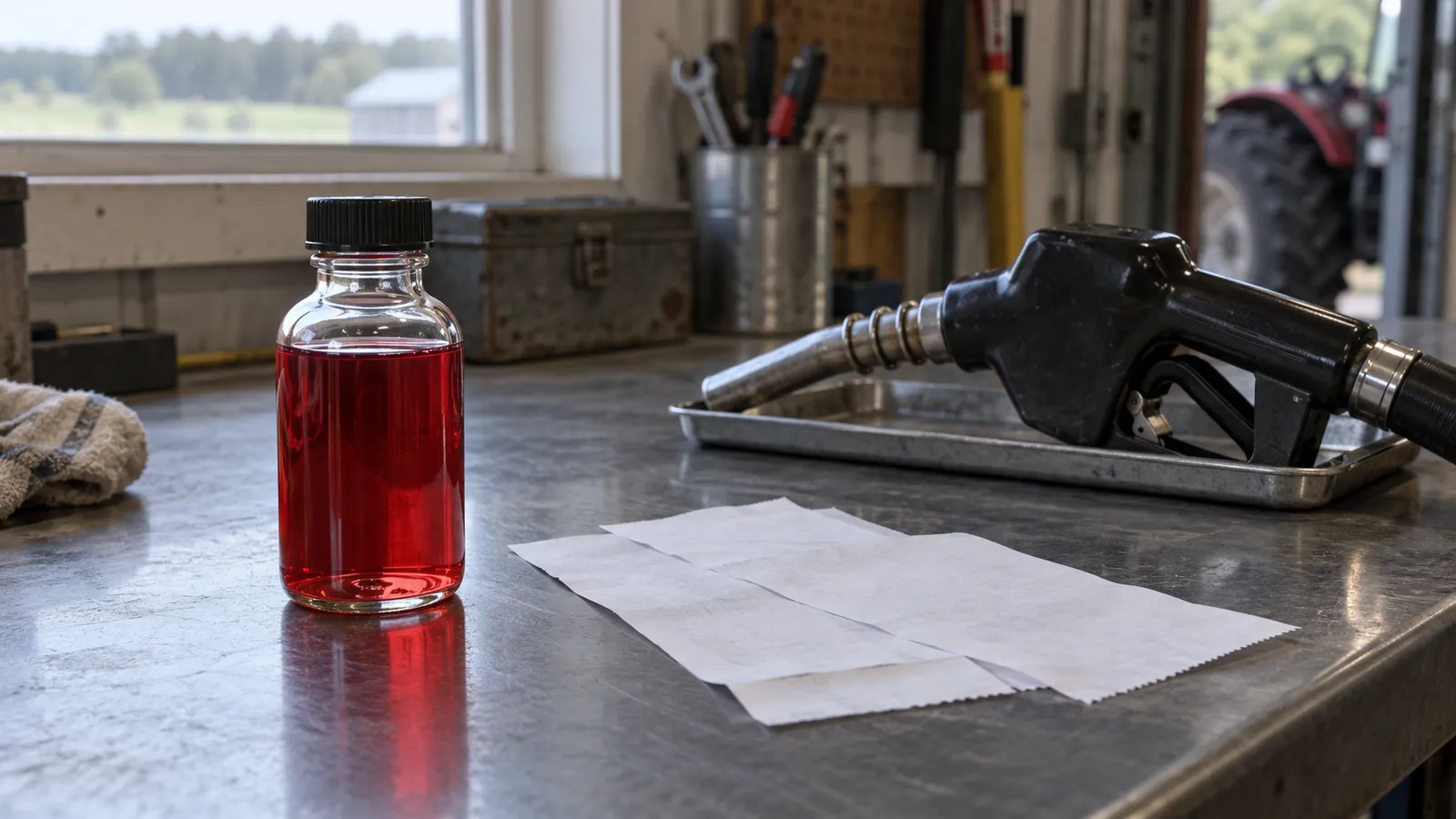
Color and sulfur content answer different questions. EPA removed its separate requirement that highway diesel be free of visible red dye in its 2020 fuel-rule overhaul; the tax-code dye marker remained. The signed final rule explains that removal. A claim that EPA still bans all red highway fuel solely because of its color is outdated.
The ordinary highway fuel standard is ultra-low-sulfur diesel, with no more than 15 parts per million sulfur. A red product is not automatically unsuitable, but the color alone cannot establish its sulfur content. Tax relief does not turn a higher-sulfur product into compliant fuel. EPA describes the diesel standards.
EPA's October 5 Texas waiver illustrates how narrow an exception can be. Through October 24, it allows specified low-sulfur fuel in older engines designed and certified for that fuel, excluding engines with diesel particulate filters or catalytic emission-control equipment. It requires the fuel to be kept separate from ULSD and a warning to owners or operators. That waiver is not general permission for modern trucks to use heating oil.
The dates that matter for fuel already in a tank
The date of purchase is not the only date that matters. Fuel can remain in a tank after a relief period ends. Iowa's proclamation allows covered vehicles to use dyed diesel without penalties only for as long as the proclamation lasts, and its later state deadline does not extend the federal window. Iowa limits its relief to the proclamation's duration.
Trump signs the order; the specified federal relief window begins.
Iowa signs its expanded agricultural proclamation, with a February 4, 2027 end date.
Missouri replaces its earlier order with broader dyed-fuel enforcement relief.
The five-day deadline for the Treasury determination and directed penalty announcement arrives.
The federal order’s covered period and Missouri’s order end; Iowa’s agricultural window runs longer.
What to confirm before a highway fill-up
Confirm that the federal relief covers you and that your trip and fuel meet the applicable state and EPA rules. Interstate operating questions may call for transportation-law help. The order keeps federal motor-carrier safety audits and inspections in place. Fuel-tax relief does not suspend those checks.
- The operative Treasury or IRS guidance, including eligible taxpayers, conditions and any deferred-tax payment date.
- The rules for every state on the route, and whether the vehicle’s actual load qualifies.
- The fuel’s sulfur specification and any limits in an applicable EPA waiver.
- Fuel purchase receipts, relief deadlines, and what happens to dyed fuel still in the tank when a window closes.
Red diesel questions
For a local supply inquiry, the order names agricultural co-ops and rural fuel distributors among the organizations USDA must work with to improve access. That is a place to ask, not a guarantee of stock or highway eligibility. Section 7 identifies the supply channels.
Why is red diesel normally illegal in a road truck?
Red diesel is normally sold for qualifying uses that are exempt from the highway diesel excise tax. Using it on a highway can create a tax bill and a separate penalty. The temporary order directs relief from specified federal penalties; state restrictions still apply.
Can I use red diesel in my truck if I live in Iowa?
No, living in Iowa alone does not qualify you. Iowa's temporary state relief covers a personal pickup only when it is hauling one of the agricultural products listed in the proclamation. Federal requirements remain separate.
Where can I buy off road diesel?
Agricultural co-ops and rural fuel distributors are places to ask about off road diesel. Having fuel in stock does not establish that your highway use qualifies for relief; its sulfur specification also matters.
Does mixing red dyed diesel with regular diesel remove the legal problem?
No. Adding taxed fuel does not cancel the tax treatment of dyed fuel already used or establish eligibility for relief. Iowa's relief, for example, applies only for as long as its proclamation lasts.
Need a lawyer?
Dealing with something like this?
Legal issues like this affect people and businesses differently. A lawyer can explain what it means for you, and we can help you find one.
Juricue is not a law firm and doesn't give legal advice. Contacting us doesn't create an attorney-client relationship.